




Updated 6.10pm with Economy Minister and Malta Business Bureau reactions
The European Commission has proposed revisions to the EU’s Emissions Trading System (ETS) that would ease costs for cargo transhipped through Malta and other EU ports.
The proposal, however, stops short of helping most Maltese businesses and consumers, who would continue paying the levy in full.
The commission on Friday proposed a raft of changes to the EU’s Emissions Trading System (ETS), a levy on emissions first introduced in 2005 to cover industrial and energy production and later expanded to include aviation and shipping.
Among the proposed changes, Brussels want to exclude long-distance transhipment cargo brought to EU ports on large container vessels if bound for ports outside the bloc.
Cargo bound for the EU – including goods imported for use in Malta itself- would still be taxed at the current rate and would not be affected by this exemption.
Under the current rules, 100 per cent of emissions from voyages between European Economic Area (EEA) ports are subject to the levy, while voyages starting or ending outside the EEA are taxed for half of the emissions produced.
The revision covers container ships capable of carrying 10,000 standard 20-foot containers or 5,000 40-foot containers and travelling more than 300 nautical miles to reach an EU port. The measure would be temporary, lasting until the end of 2035.
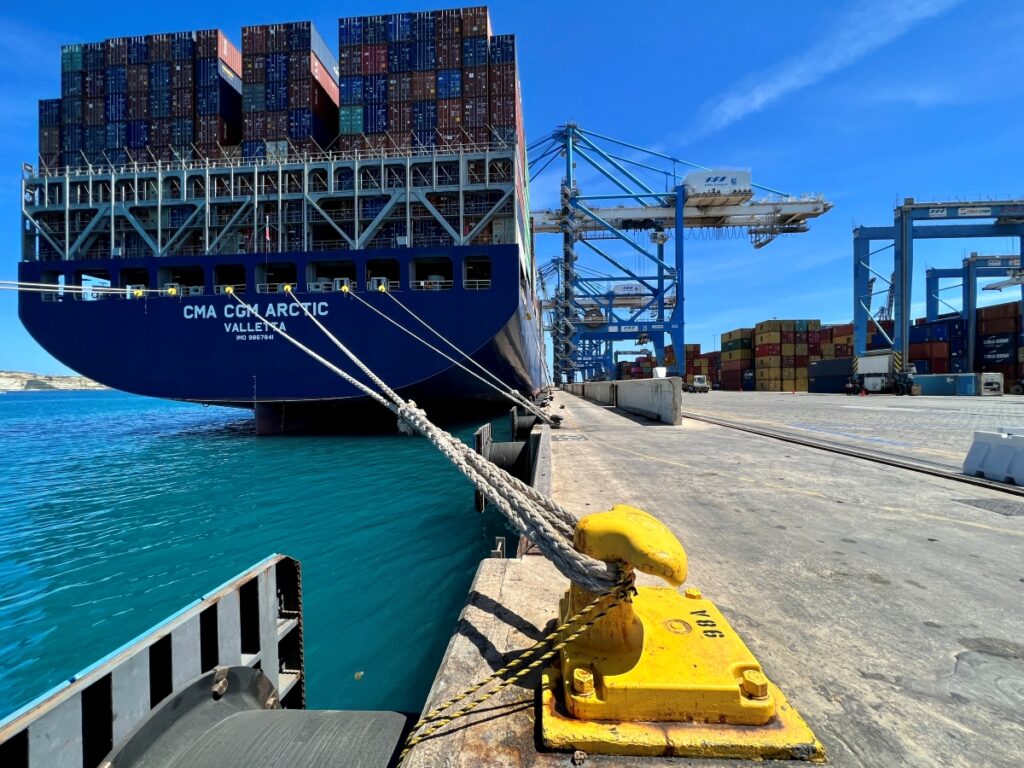
If approved, the change would be good news for Malta’s transhipment business – cargo that arrives in Malta only to be transferred to another vessel bound elsewhere – primarily at the Malta Freeport.
While Malta’s geographic location makes it an ideal hub for transhipment, critics of the EU rules argued that the new levies were encouraging shippers to divert such cargo to non-EU ports and avoid the extra fees.
While non-EU ports Tangier Med in Morocco and East Port Said in Egypt currently fall under the scheme, classed as ‘neighbouring ports’, ETS levies only apply to vessels calling at those ports destined for the bloc, with international transhipment excluded.
The Commission’s new proposal would appear to effectively level the playing field, seeing transhipment passing through EU ports granted a temporary exemption in line with North African rivals.
The transhipment levy concern is distinct from a broader issue with ETS payments facing Malta: an increase in shipping costs for all goods imported into the island.
Malta’s MEPs and government warned earlier this year that Malta was facing ‘disproportionate‘ costs as a result of those ETS fees.
Also read: Freight costs up €654,000 a week for Malta as fuel surge, EU ETS hit operators
Economy Minister Silvio Schembri said it was “still too early to draw firm conclusions from today’s proposals”, noting the government would be carrying out a detailed technical assessment of the measures together with relevant authorities and industry stakeholders.
“At first glance, it is encouraging that the commission appears to recognise the importance of balancing climate ambition with European competitiveness and investment,” he said.
“However, our priority will remain ensuring that any final agreement safeguards Malta’s economic interests, preserves a level playing field for our businesses and reflects the realities of an island economy. We will actively participate in the negotiations to achieve that objective.”
‘Change can happen’
Welcoming the proposals, Maltese MEP Peter Agius, a vocal critic of the emissions trading system, said the requested revisions were “testament that when we apply pressure, the EU can respond … when you [the public] ask MEPs to act, change can happen”.
But Agius was clear that the Commission proposal as it stands only addresses transhipment. He said lawmakers should “salute this step” but that it should also signal “a common Maltese effort to push for further changes”.
The MEP said cargo bound for EU ports like Malta, and not destined for transfer to other ports, should also be exempt from the levy, arguing ETS was making goods more expensive for Maltese consumers.
Similar concerns have been raised by industry stakeholders in the past, who argue Malta suffers disproportionately under the scheme due to its reliance on imports.
Agius said the exemption for shipments destined for EU ports was a “major request” of the European People’s Party (EPP) within the European Parliament, to which Agius belongs, and one that had found support from allies in fellow Mediterranean countries Spain, Italy and Greece.
The proposal is not yet final. It must still be negotiated between the Commission, European Parliament and Council before taking effect, a process expected to play out over the coming months.
Read also: ‘Malta should be part of this’ – MEP on European emissions tax revolt
‘The change has been too fast’
But with ETS introduced as a key measure to bring down greenhouse gas emissions, what is Agius’ response to those who argue such a goal remains an important one, especially in light of the recent record-breaking temperatures across Europe?
“Because by simply diverting to Morocco, you get out of paying it,” said Agius, adding that, “if you’re passing through the Mediterranean to North Africa, you’re still polluting our air. I believe in fighting climate change, but the change [adoption of the levy] has been too fast”.
Agius may face pushback from environmentalists, however; European Environment Agency figures show that greenhouse gas emissions have roughly halved since ETS’ introduction in 2005. Green improvements to energy production and the EU economy, as well as other emissions cuts, have also been credited for the improvement.
Read also: No to a ‘one size fits all’ EU approach
Away from changes to ETS shipping rules, the package proposed by the commission also includes reduced caps on emissions charges, and offering more financial support to companies investing in clean technologies within Europe.
The reforms Brussels is proposing would allow European industry to carry on carbon emissions for a longer period and at a lower cost than previously set.
Companies that commit to investing in decarbonisation efforts would be able to get free carbon allowances until 2038, instead of 2034 as was previously the case.
Proposals ‘fall short’, says business community
Reacting to the proposals, the Malta Business Bureau (MBB) said the proposed package “falls short of proposing tangible measures which will reduce costs for maritime and aviation operators”.
MBB CEO Mario Xuereb said the bureau “supports ambitious decarbonisation, but the structural realities of island states, higher transport and energy costs, limited economies of scale, and import dependence, must be reflected in the design of the EU ETS”.
He warned that without “targeted safeguards, the reform risks overburdening Malta with the costs of decarbonisation, without reaping any of the benefits.”
US pressure and waning EU resolve
Meanwhile, hopes of extending ETS aviation levies to long-haul international flights were reported to be waning earlier this year over concerns of a possible retaliatory response from the Trump administration.
Last year, the US sunk efforts by the International Maritime Organisation to introduce binding international rules to cut shipping greenhouse gas emissions, including threatening tariffs and other economic penalties on those supporting the measure.
The expansion of ETS to shipping was met with concern in Malta when news of it broke in 2023, with the freeport warning the levy, which charges shipping companies based on their emissions, would ramp up the costs of imports and exports.
The EU has spent the past years caught between a push to decarbonise member state economies to hit climate targets and reduce reliance on non-EU energy sources, and calls to ease decarbonisation targets to make the bloc more globally competitive.


