Widened tax brackets for parents with children announced in the last budget are expected to cost at least €350 million over the course of three years, a Central Bank analysis shows.
Approximately 68,000 parents are expected to benefit from the tax reductions, according to the finance ministry, leaving an average tax saving of about €2,400 per parent in 2028.
The widened brackets, to be gradually implemented over three years, are a Budget 2026 measure intended to potentially incentivise families to have additional children.
By 2028, parents of two children and over will only begin to pay taxes once their income exceeds €37,000, which would be an increase of €22,000 over three years compared to today.
Revenue impact and structure of the tax system
But the loss in tax revenues will not be insignificant.
A Central Bank analysis published in its quarterly Economic Outlook predicts that this will lead to a €62.6 million reduction in tax revenue in 2026, which increases to €117.8 million in 2027 and €170.3 million in 2028.
Malta’s existing income tax framework is composed of three classes of tax brackets: ‘single’, ‘married’, and ‘parent’ for those with children under 18 or aged up to 23 and still in education.
The majority of the fiscal cost arises from households assessed under the more generous parent computation, reflecting the greater prevalence of dual-earner families in this class.
The married computation is often more advantageous for households where one member is not employed or earns a relatively low income.
By 2028, parents with two or more children will account for €94 million (55%) of the €170 million in revenue losses, consistent with the reform’s aim at significantly raising tax-free thresholds for larger families.
Less pressure on wages
The latest financial estimates show that around €3.2 billion will have been collected in income tax for 2025 – roughly 12% of Malta’s €26.6 billion GDP.
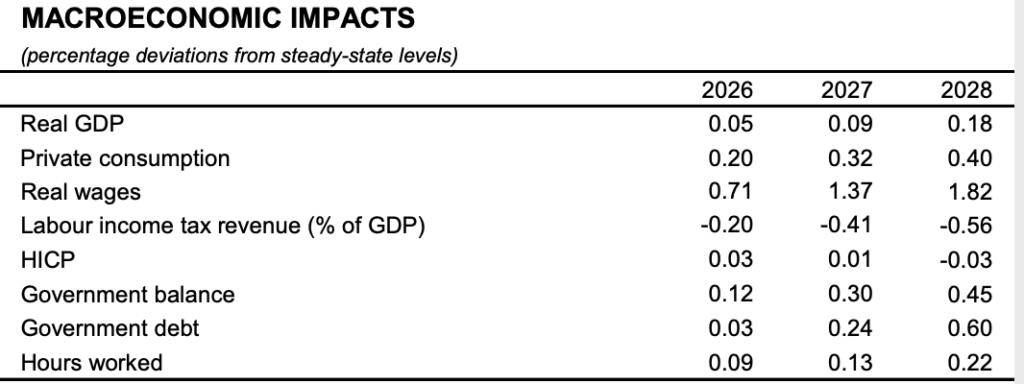
However, the parent tax reform is still expected to add a minimal 0.18% to the level of GDP for the period 2026 – 2028.
The Central Bank predicts that with a lower tax wedge, there will be less pressure on wages, in turn helping to keep the costs of production from rising further.
By keeping the marginal cost of production stable, this should improve the price competitiveness of Maltese exports.
Additionally, with more money in people’s pockets, the lower tax bill boosts income and private consumption.
This will effectively lead to a minimal 0.05% bump in GDP in 2026, climbing to 0.18% in 2028.
Owing to the design of the tax cut, it will be middle-income households that gain the most, although lower and higher-income households also benefit substantially.
Higher-income beneficiaries are liable to save a bigger share of the tax cut, which explains part of the upward revision to GDP growth over the period 2026-2028.
For lower-income households, the gains might be more modest due to the limited number of tax-liable individuals, which already enjoy targeted benefits and allowances.
Due to increased thresholds for each parent with two or more children, the maximum tax savings will amount to €1,625 in 2026, €3,250 in 2027, and €5,000 in 2028.
For parents with an income of €42,000, each will benefit from a total tax saving of around €10,000 with the average expected tax saving per parent at the end of the third year projected to be €3,500.
The latest tax cuts for parents follow up on measures announced the previous year in Budget 2025, where around 290,000 taxpayers benefited from €140 million in tax cuts.