MAProHand (Minimal Anthropomorphic Prosthetic Hand). Photo credit: UM Robotic Systems Laboratory.
If your first image of a robot-filled world is glossy androids marching down Republic Street, it’s time to think again.
The reality is quieter, and much more useful.
In a lab at the University of Malta, a tall, wheeled robot glides across the floor, its slim arm stretching out like a helpful butler on wheels.
A few benches away, a black robotic hand calmly grips a Rubik’s cube, its fingers flexing with almost human ease.
This is where Malta’s robotics story begins: with practical machines designed to make life and work a little easier.
From neat lab to messy world
Ask any roboticist and they will tell you the same thing: the real world is a nightmare for robots. Floors are uneven, people walk unpredictably, lighting changes, furniture moves.
Professor Marvin Bugeja, Department of Systems & Control Engineering at the University of Malta, has been building smart wheelchairs and mobile robots for over 20 years.
He describes the key lesson simply: outside the lab, everything is ‘messier’ and more uncertain. So his team designs robots that can cope with surprises.
Fusing data from multiple sensors, learning from their mistakes and adapting their behaviour over time. A bit like a human getting used to driving an unfamiliar car.
One project is a smart wheelchair that can guide a user safely through narrow doors or crowded spaces. It can even drive them autonomously to a point they select on a map.
Another is a home security robot that patrols a house, detecting intruders or hazards such as fire and gas and sending live video back to the owner.
A third is a transport robot that learns how to move precisely even when its own weight or load changes.
For businesses, this is the important bit. These robots are built for awkward, unpredictable, human environments – the kind we all actually live and work in.
Robots with a human touch
If the University of Malta is the engine room of ideas, Kingswell Innovation (KI) is where some of those ideas turn into commercial products.
Kingswell Innovation is a Maltese robotics company that specialises in ‘accessible automation’.
This means robots that tackle boring, repetitive or hard-to-staff tasks in factories and businesses so people can focus on judgment, creativity and human contact.
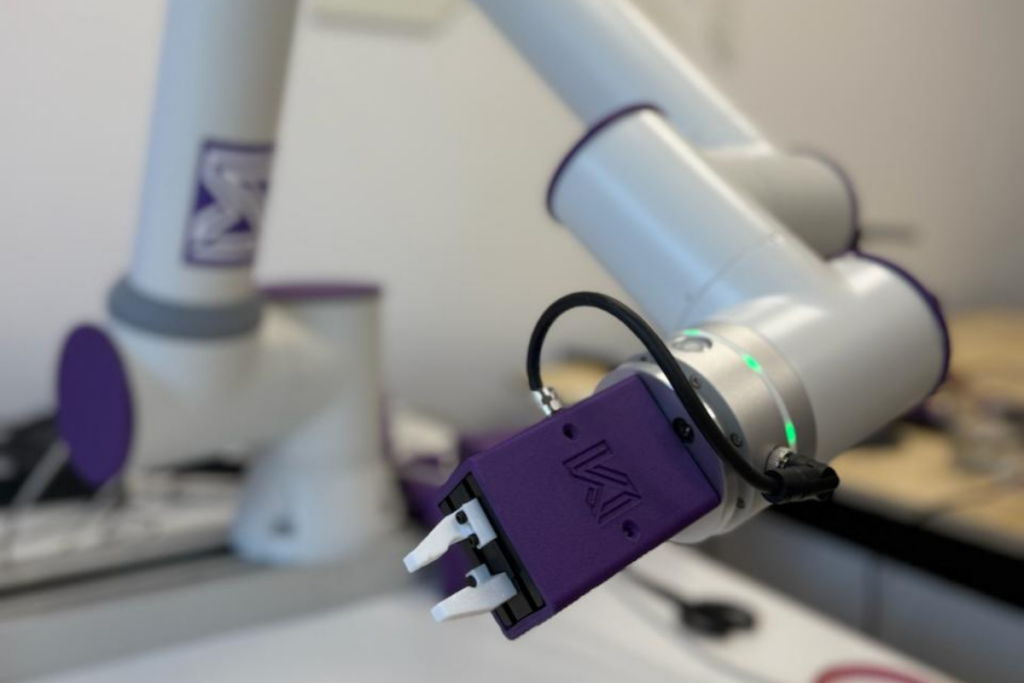
They visit a site, watch how people actually work and map the real bottlenecks. Sometimes the answer is not ‘buy a robot’ but ‘first fix the workflow, then automate the right bits.’
One of their flagship creations, FlexHand, began as a passion project: a highly dexterous robotic hand that has gone through many iterations. It has become tough, reliable and versatile enough to be used on an industrial arm or mounted on ‘Freddie’, their humanoid platform.
Malta – the perfect testbed
Malta’s size could have been a deterrent for robotics – fewer people, smaller companies, limited funding. But the people building these machines see something else – a perfect testbed.
As Prof. Emmanuel Francalanza (University of Malta, Faculty of Engineering) notes, “the adoption of collaborative robotics in Malta has accelerated considerably in the past years, as companies see how intuitive cobots can speed up setup and reconfiguration while keeping humans and robots working side by side.”
The university sees similar benefits from the research side too.
The group led by Professor Michael Saliba (Department of Mechanical Engineering, University of Malta) has spent years exploring prosthetic hands, assistive robots and what they call ‘robot-inclusive spaces’ – homes and buildings designed from the start to be easy for robots as well as humans.
That may sound abstract, but it is a quietly radical idea.
Instead of building ever more complex – and expensive – robots to cope with our cluttered environments, why not also simplify the environments so cheaper, simpler helpers can do more? Their MARIS (Mobile Assistive Robot in an Inclusive Space) prototype was an early demonstration of how such a helper might navigate an adapted space.
New projects, new partners
Right now, Saliba’s team is launching three new projects that show how firmly they are thinking beyond the lab.
One aims to analyse human hand dexterity in detail and turn that into a practical test that clinics and employers can use to assess manual skills.
Another uses artificial intelligence to help design soft robotic grippers. A third project pairs a versatile gripper with a drone to pick up litter that has been spotted by AI in aerial images of Malta’s countryside, in collaboration with the Cleansing and Maintenance Division.
Over the years, the robotics group has also worked with local factories to improve processes, with the plants providing real-world testbeds and feedback, and the researchers offering new tools and methods in return.
The hard bit: leaving the nest
If all this sounds like a straight line from clever idea to useful product, the reality is more complicated.
Saliba is candid about the obstacles. The students who know a system inside out often graduate and move on just when their expertise is needed to turn a lab demo into a business.
Funding for hardware is expensive and long-term, and small countries have to make tough bets about what to back.
KI feels similar pressures from the business side. Hardware robotics requires more capital and patience than many software startups. And in a small market access to sustained funding is difficult.
That is why they argue for more structured support for hardware development, quicker procurement for innovative solutions and flexible business models such as leasing, so smaller companies can afford to adopt robots without huge upfront costs.
If those pieces fall into place, they believe Malta could export compact, niche robotic solutions designed specifically for small and medium-sized enterprises.
People, not just machines
For all the excitement about hardware, the people behind Malta’s robots insist that humans remain at the centre.
Roboticists talk about ‘co‑workers’, ‘assistants’ and ‘partners’ rather than replacements. In education, this message is becoming mainstream too.
As Prof. Matthew Montebello (Department of Artificial Intelligence, University of Malta) explains, Malta’s AI and digital education strategies “treat AI and robotics as opportunities for better jobs and quality of life, not threats to them, preparing people to collaborate with both hardware robots and software ‘softbots’ in everyday work and learning.”
For example, in healthcare and daily living, the goal is to restore independence, not to remove carers from the picture.
Perhaps Malta’s greatest opportunity lies here: using its small, tightly knit ecosystem as a living laboratory for human centred automation.
Local researchers can co-design systems with clinicians, factory workers and cleaners; local companies can build and service them; and local authorities can see, quickly and concretely, what works.
For a small island, that is a big role to play in the global robotics story. Not by outspending bigger countries, but by outlearning them in how people and machines work together.
So, our glossy robots are not marching down Republic Street (yet), but are being born in Malta’s labs – and are quietly finding their way into the island’s daily rhythm.