
The dos and don’ts of modern AML practice were highlighted during a seminar organised by the Institute of Financial Services Practitioners (IFSP).
As financial crime becomes increasingly complex, organisations across all sectors face growing challenges in keeping up. The need for a practical approach to Anti-Money Laundering (AML) has never been clearer.
This was the focus of the IFSP’s recent seminar, which brought together industry professionals and regulators to discuss what a strong Risk-Based Approach (RBA) looks like in practice and why it is central to modern financial crime prevention.
A highlight of the seminar was a presentation by Andrew Strijker, an international expert in AML and financial crime prevention.
Strijker currently serves as Senior Advisor to the Dutch Anti-Money Laundering Centre, works closely with Europol, and is involved in multiple European initiatives on financial intelligence and threat analysis.
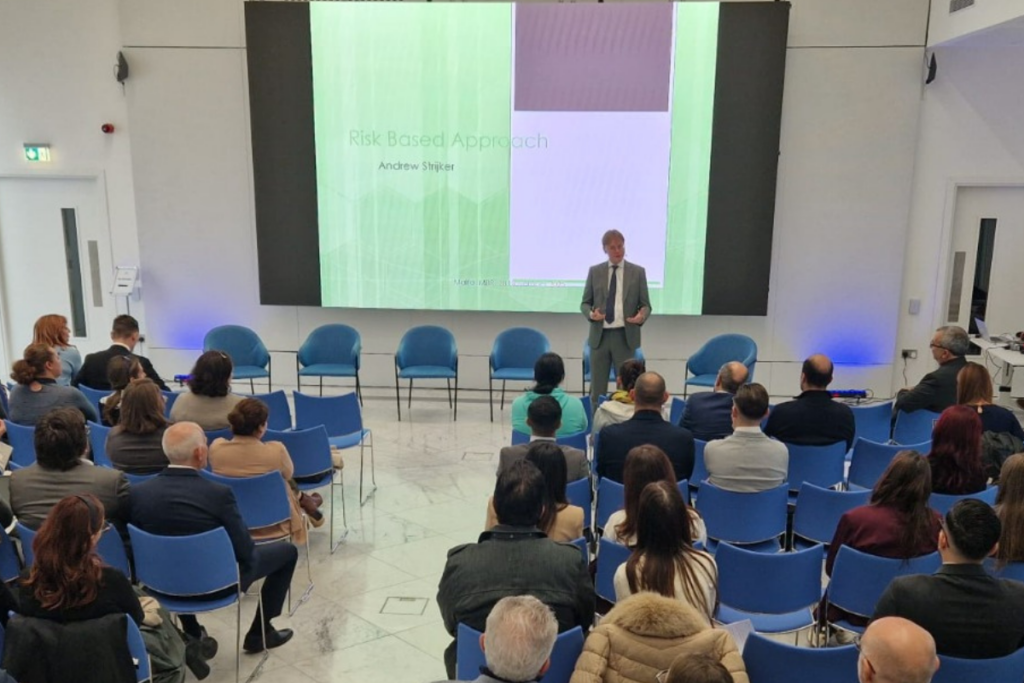
Strijker began by explaining the basics of RBA in simple terms.
At its core, RBA is about understanding where the risks lie, whether with customers, locations, products, services, or transactions and applying controls that are proportionate to those risks.
It is not just a regulatory tick-box exercise, it’s the foundation for effective decision-making, governance, and policy within organisations.
Strijker stressed that moving from a rules-based approach to a risk-based approach requires judgement, insight, and continuous analysis.
While this brings more responsibility, it also allows institutions to tailor their controls intelligently rather than relying on generic checklists.
The presentation highlighted why RBA matters more than ever. Global financial crime is becoming more complex, compliance expectations are rising, and organisations are now measured on effectiveness rather than simply ticking boxes.
He warned against relying on outdated geographic risk ratings, ignoring emerging risks, misaligning with national or sectoral risk assessments, or using overly broad entity-level assessments.
Practical examples from banking, legal services, and other sectors helped attendees see how RBA works in real life.
Common mistakes like treating all customers the same, applying controls mechanically, or failing to document reasoning were clearly illustrated, making the guidance immediately actionable.
With the support of the NCC and FIAU, a panel discussion moderated by Ariane Azzopardi was held and featured Andrew Strijker, Yehuda Shaffer, Alex Mangion, Ryan Caruana and Vanessa Vella.
The panel explored challenges faced by subject persons in Malta, including gaps in customer information, resourcing pressures and inconsistent risk interpretation.
The discussion reinforced the points raised in Strijker’s presentation, especially the need for clarity, proportionality and alignment across the industry.
Overall, the IFSP seminar offered clear, practical guidance on a topic that often feels complex.
Participants left with a stronger, more practical understanding of RBA, how to apply it intelligently, with a clearer path toward effective AML compliance.