
In an era marked by rising regulatory expectations and heightened scrutiny of financial institutions, IFS Malta together with Ganado Advocates, brought together leading regulators, practitioners, and governance experts for a half-day conference titled ‘Governance: Navigating Risk, Regulation and Reputation’.
Hosted at the Malta Financial Services Authority (MFSA), the event explored the evolving dynamics of risk management, compliance, oversight, and corporate reputation, providing crucial guidance for board members, compliance professionals, auditors, and executives across the sector.
The morning opened with an introduction by Dr Conrad Portanier, Partner at Ganado Advocates, who set the tone for the discussions by stressing that the industry’s collective responsibility to uphold strong governance frameworks in an increasingly complex financial environment.
His remarks were followed by the keynote address delivered by Catherine Galea, Head of Banking Supervision at the MFSA, whose intervention underscored the centrality of internal governance as a core pillar of prudential supervision.
Strengthening internal governance across the sector
Galea highlighted that recent international banking failures, including Credit Suisse and Silicon Valley Bank, demonstrated that “weak governance and risk-management failures, rather than liquidity or capital shortages, remain the true root causes of instability.”
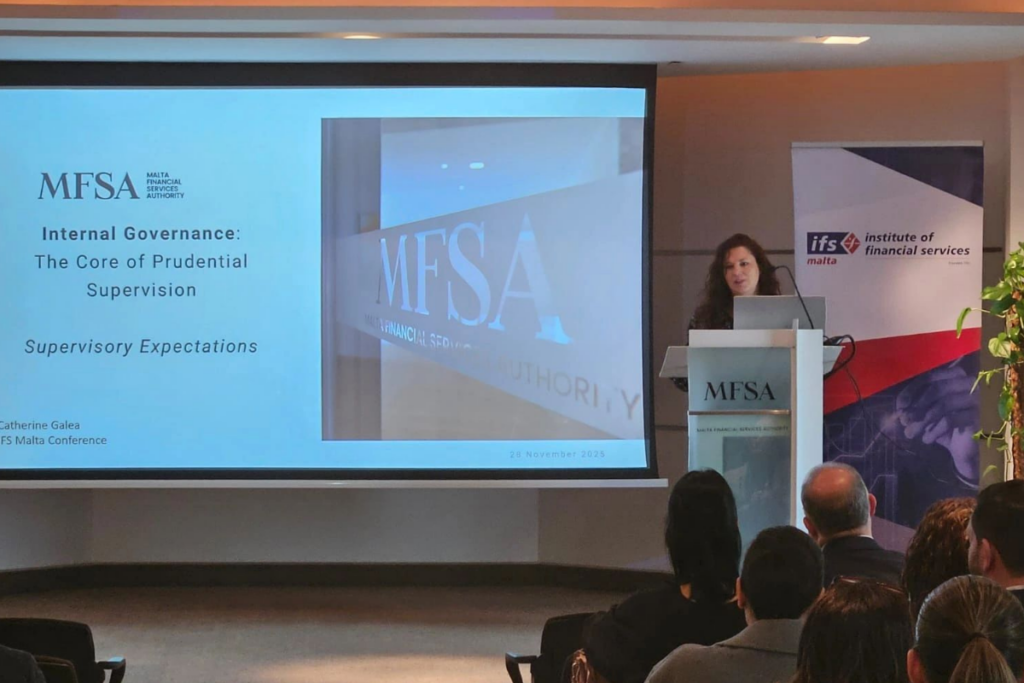
Drawing on supervisory insights, she outlined the Authority’s expectations for boards and non-executive directors, noting the critical importance of strategic oversight, board diversity, independence of mind, and a strong risk culture.
She reiterated that internal governance is not simply a regulatory requirement but a foundational component of financial resilience.
Her address also previewed the MFSA’s upcoming publications designed to provide further clarity on governance expectations as well as the regulator’s ongoing alignment with evolving EU frameworks.
A panel discussion ‘From the Boardroom: Implementing an Effective Governance Structure’ followed, bringing together senior representatives from APS Bank, Bank of Valletta, Ganado Advocates, and the MFSA.
Moderated by Dr Portanier, the conversation focused on how boards can translate regulatory expectations into practical, sustainable governance structures.
Later, attention shifted to the internal audit function with a presentation by Juzer Rangwala, Senior Manager in Internal Audit at KPMG.
Rangwala positioned internal audit as the independent ‘third line’of defence, essential for safeguarding organisational value.
He emphasised that internal audit not only provides assurance on governance, risk management, and internal controls but also delivers strategic insight that helps institutions enhance operational efficiency.
Advancing internal audit and compliance capabilities
Rangwala outlined how internal audit plays a vital role in reinforcing accountability, assessing fraud risk, and building stakeholder confidence, areas of growing importance amid mounting regulatory pressures.
He also highlighted priority focus areas emerging in the sector, including financial and operational resilience, enterprise risk management, AI systems oversight, and improved audit reporting practices.
The conference continued with a presentation titled ‘Beyond the Rulebook: Navigating Compliance in Financial Services’ delivered by Caroline Grech, Chief Compliance Officer at MeDirect.
Grech underscored the shift from traditional compliance, focused on adherence and checklists, to a proactive, strategic compliance culture.
She detailed the challenges posed by regulatory complexity, rising compliance costs, and fragmented data systems, urging institutions to transition toward risk-based, continuously monitored compliance frameworks that leverage automation, artificial intelligence, and RegTech solutions
Her discussion also highlighted the growing relevance of ESG-related compliance, shaped by frameworks such as the Sustainable Finance Disclosure Regulation (SFDR) and the Corporate Sustainability Reporting Directive (CSRD).
Grech presented a case study demonstrating how centralised systems and strengthened governance can transform compliance outcomes and prepare institutions for future regulatory harmonisation.
Embedding culture at the heart of risk management
The final panel of the day ‘Risk Management: Balancing Compliance, Culture, and Control’ moderated by PwC Partner Norbert Vella, brought together experts from Ganado Advocates, Rizzo, Farrugia & Co., the University of Malta, BNF Bank, and HSBC.
The discussion explored the interplay between risk culture, regulatory compliance, and operational control, with panellists stressing that effective risk management requires both technical competence and strong organisational culture.
Closing the event, IFS Malta thanked speakers and participants for contributing to a robust and forward-looking dialogue.
The Institute reiterated its commitment to supporting the industry as corporates navigate heightened regulatory expectations and strive to strengthen accountability, transparency, and resilience.